Blog: Week 7 | Material Expression
- up915094
- Mar 24, 2022
- 6 min read
Updated: Aug 4, 2022
PROPOSE | Detail Application
Key words: Organic, natural, sustainable.
"Organic buildings are the strength and lightness of spiders spinning, buildings qualified by light, bred by native character to environment, married to the ground." - Frank Lloyd Wright
Area of IMP for exploration

I decided to explore this part of my reception/café area, as this allows me to express the counter design and bespoke seating. I will not be exploring the detail of the door and wall included within the rectangle, as I want to go into the other more interesting aspects in closer detail.
This part of the IMP was of particular interest to me as the bespoke seating is something that's unique to my project, so I thought this would be an engaging aspect to investigate in close detail.
The counter design is also something that I can tailor specifically to my own project, and there are many opportunities for playing with materiality in this sense.
Reflections on Making
Precedent
The first material investigation which I carried out via a making process was inspired by
GlassEco Surfaces & Fisher Recycling. I came across this company as I was researching countertop designs for my reception desk, and I loved the concept of taking recycled glass and giving it a new use. The end result is elegant as well as eco friendly.


"Unfortunately, many restaurants and hotels don’t realize that glass being put in a “blue bin” is not truly recycled and is instead taken to a landfill. We want to divert this glass for our community and give it new life in other products. It does make a difference!" — Elizabeth Fisher, Owner of GlassEco Surfaces & Fisher Recycling
Making Process: Glass and Concrete


1. Soak
I began by soaking the bottles in hot soapy water in order to help me remove the labels easily.
2. Smash
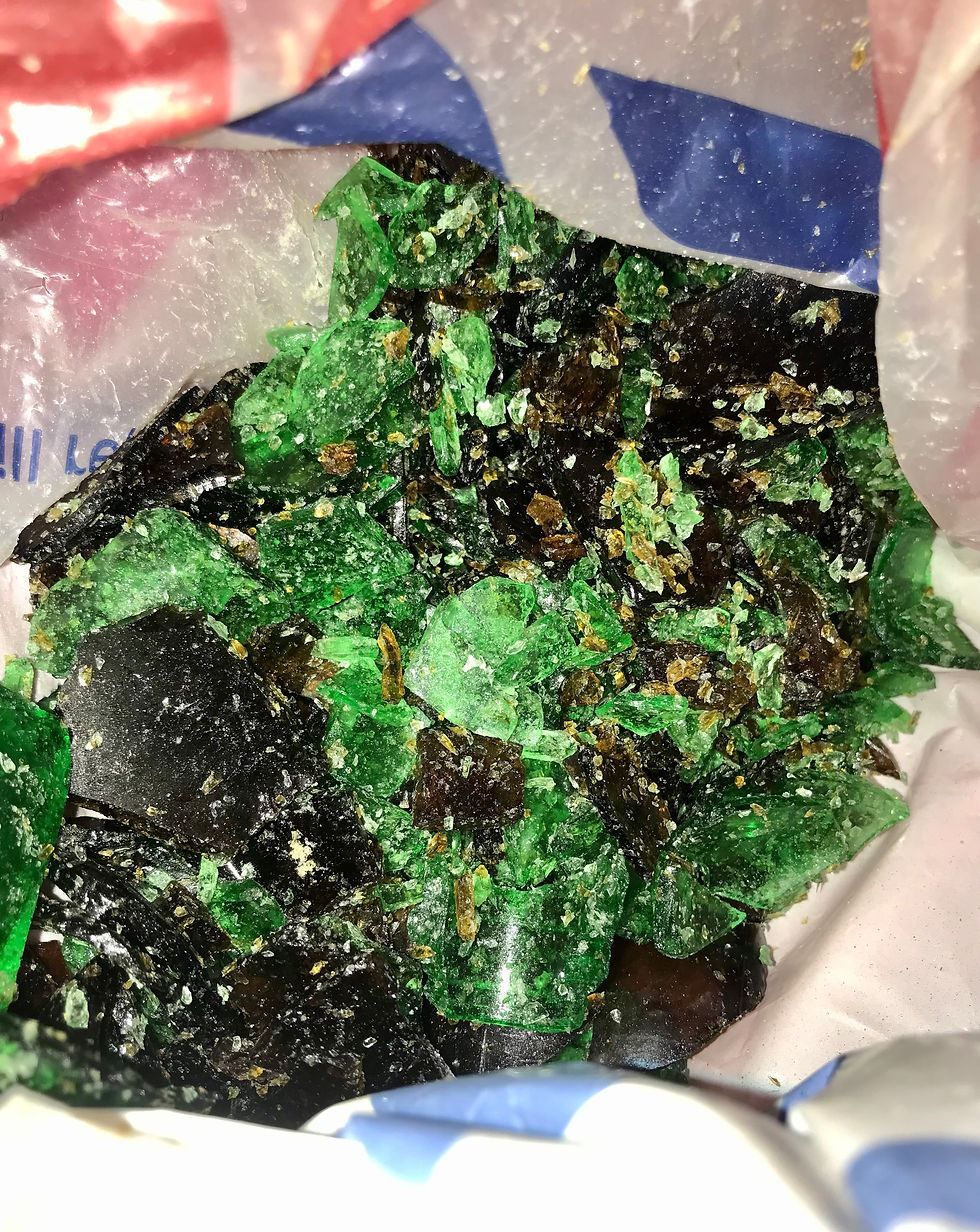
The next step was to smash the glass up into smaller chunks. In order to do this safely, I wrapped the glass in three plastic bags, followed by cello tape to ensure no shards of glass escaped.


3. Mould
Next, I created some moulds for the concrete and some other materials I was interested in exploring. I did this by cutting foam blocks to a small sample sizes, which were then put into the chamber vacuum sealer. This heats plastic until it is malleable, and then lowers it onto the material, taking on its shape and picking up every detail. I chose this method as I was told it was the most water-tight, which made it appropriate for pouring concrete into.


4. Mix
We began to mix the concrete using a 1:1 ratio of dry concrete mortar to water. This forms a paste which then binds together with aggregates. The water in concrete is the catalyst that allows chemical bonds in the cement to form during a chemical reaction called hydration, wherein the concrete hardens and increases in strength. This will then begin to set.


5. Pour
I was advised by the workshop technician that unfortunately, the glass pieces may get lost in the concrete. To try and counteract this effect, I put some of the larger shards of glass at the bottom of the mould, in hopes that these would show up and create the desired effect.

6. Remove
After leaving the concrete to set for a few days, I returned to the workshop to see the result.

7. Analyse
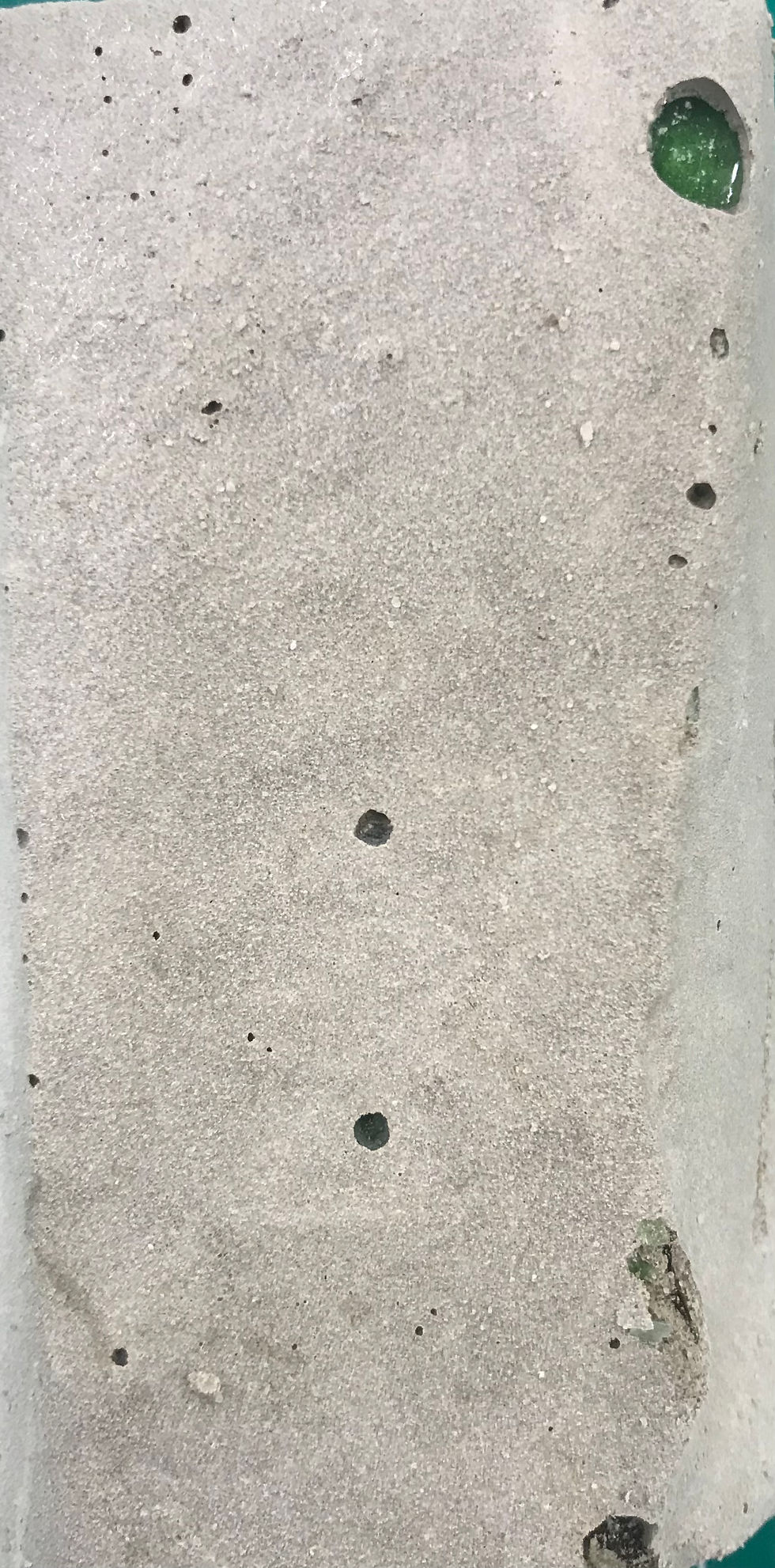
After cutting the concrete blocks out of the mould, I noted that unfortunately, the glass shards weren't really visible within the concrete. This was something that I didn't expect to happen as I didn't realise the concrete would completely coat the glass. However, it did create several air pockets which added a level of texture to the material.
8. Reflect
Upon reflection, if I were to do this again, I would coat the glass in the right substance to prevent the concrete from sticking. It is possible to coat glass with oil based, chemical blends such as linseed oil, mineral oil and paraffin. This makes the surface of the glass stick-resistant. There are also water-based alternatives made from plant-based materials such as vegetable oils. These wont discolour the concrete surface, allowing for a finish which stays true to the original material.
Making Process: Foliage and Fabric with Resin


1. Prepare
First, I prepared the materials by cutting ribbon to shape and picking petals and leaves off of a bouquet of flowers.


2. Arrange
Next, I placed the materials into the mould. I mixed some foliage in with the fabric in order to see how these materials might interact together.


3. Mix
To prepare the resin, we mixed in the activating agent which allows the resin to begin setting. It was important to mix this in properly so that this process worked correctly.

4. Pour
Once the resin was prepared, we poured it over the material and into the moulds. We ensured all of the material was underneath the resin so that it all set within it securely.

5. Remove
Once the resin had time to set properly, I cut the mould around the materials in order to remove it. I was advised to leave it encasing the underneath in order to achieve a smooth, clean finish.


6. Analyse
The fabric mixed with foliage created an interesting effect. However, the resin definitely dulled the shine of the material, and made the overall finish very dark which I didn't really like. The resin also took the green out of the foliage, making it look very dead.


The resin mixed with purely foliage was my favourite, as it had quite an elegant effect which preserved the flowers nicely. This is something that I would be interested in exploring further within my IMP, potentially for a counter-top finish. Upon reflection, I would have used flowers which were far more fresh. Although they weren't really dying as I brought them into the workshop, by the time the resin had set they did begin to yellow.
Flowers Set in Resin


Reflections on Material Exploration
Recycled Rubber
After research into a variety of materials, I am interested in exploring ways that I can apply this knowledge within my IMP. The use of a rubber membrane within Georges restaurant in Paris (researched in week 5) is something that I was keen to include within my design. This was due to the vibrant and playful colouring that can be achieved with this material, alongside the potential for recycled forms of rubber, making it a sustainable and environmentally conscious choice.


I decided that recycled rubber would be perfect for the interior of my treehouse-like structures. This is because it not only has the potential for bright colouring, but it has health and safety benefits to it as well. Rubber is a popular material utilised within playgrounds due to its soft and bouncy properties. This makes it perfect for the high ropes area, in which people could potentially be falling over, as people wouldn't sustain injuries.


After doing some further research, I found some rubber textures that fit with my colour scheme. I liked the specs of varying colours within this material, as it contributes organic, natural atmosphere that I am trying to achieve.
Fabric Membranes

Reflecting upon my research into fabric materials in week 6, I was inspired by the fabric membranes within the King Fahad National Library.
The technique of stretching fabric to the desired form using tension between a frame is something I am interested in recreating in some form. This could potentially be a useful method of hiding the structural columns in a creative way.
In my design, I would utilise a material other than the nylon used in this precedent, as it is not a very sustainable fabric. Nylon manufacture creates nitrous oxide, a greenhouse gas 310 times more potent than carbon dioxide. For this reason, I will be exploring alternative, more sustainable fabrics.
Further Materiality Intentions for IMP: Precedents
Coperaco Coffee: URBY Harrison, New Jersey
Materials: Foliage, wooden structural supports, marble bar and table tops, dark metallic furniture.
Coperaco Coffe in New Jersey has a similar aesthetic to my IMP, as it features repeated triangular arch forms within the centre. The sense of bringing the outside in, alongside the utilization of natural materials is something that I have envisioned for my project.


Story Coffee: Battersea, London
Materials: Wooden flooring, counter and table tops. Dark glass lighting, metal within table supports and fan.
Story Coffee uses simple, natural materials to create an overall raw and organic setting. I like the different ways in which wood has been utilised here, as this is a material I am interested in using within my IMP.


Materiality: Marble, dark green velvet, foliage.
The Samaya Coffee Shop in Dubai has an overall fresh and relaxed aesthetic, with a ceiling inspired by willow trees and chairs mimicking flower forms.


The Nuilea Spa in Madrid, Spain
Materiality: Bamboo, stained wood, foliage, strip lighting.
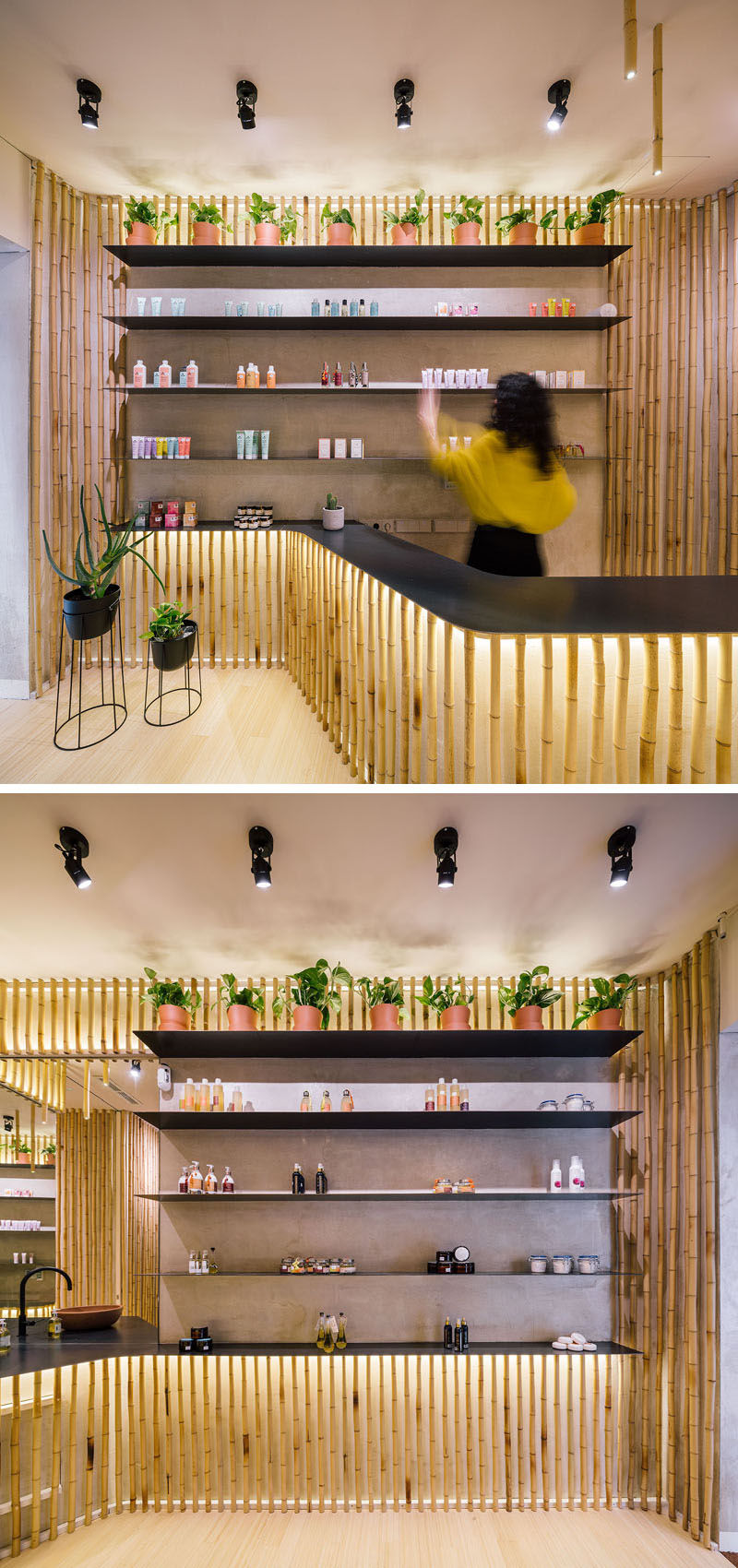
The Nuilea Spa in Spain features bamboo cladding paired with strip lighting, which highlights the material throughout the space. This is contrasted with a dark countertop, shelving, lighting and plant pots. The bamboo in particular has inspired me for my IMP as I love the overall effect of this material, and I am also considering using it for some bespoke seating so this would tie in well.
References
GlassEco Surfaces. (n.d) https://www.glassecosurfaces.com/products
Syeda, A. et. al. (2014). A case study on bamboo as green building material. https://internationalgbc.org/wp-content/uploads/2021/06/0165_10.1.1.678.7429.pdf


Comments