Blog: Week 9 | Material Expression
- up915094
- Apr 28, 2022
- 9 min read
Updated: Aug 4, 2022
PROPOSE | Detail and Hand Drawing
Key words: Propose, realise, materiality, detail.
"As an architect you design for the present, with an awareness of the past, for a future which is essentially unknown." - Norman Foster
This week, we aimed to develop the detail aspect of the Design project by using hand drawing to work through possibilities in an iterative way. I began by sketching the areas I will be detailing in 1:20. Then, I started to think about different methods of realising these in detail, alongside varying applications of materiality. I also looked into sustainable and ethical companies which I could source some of my products from. To conclude, this blog post portrays my final detail drawings.
Reception Counter Detail Exploration
For the reception counter, I am interested in using a wooden framework with some form of cladding to add depth and interest. I began by exploring different wood joints via sketches and research in order to help me decide which would be the most appropriate.
Butt Joint

A butt joint has two flat pieces of wood which simply join together either face to face, edge to edge, or on a corner. This is one of the simplest forms of wooden joint. Here, it is important that there is a tight fit which can be achieved by ensuring the ends are very smooth, or the addition of glue, nails, screws or dowels. Many of these connections can apply within many kinds of wooden joints for extra strength.
Rabbet Joint

This kind of joint comes in the form of a lip and channel cut, which joins two pieces of wood together by slotting them into each other. This is often utilised when recessing cabinet backs into the sides, or anywhere in which little visible end grain is desired. This is stronger than a butt joint and can be easily made.
Tongue and Dado joint

This joint features a slot (known as the groove/dado), and a thin, deep ridge (referred to as the tongue), on the opposing edge. The tongue projects slightly less than the groove, allowing two or more pieces to fit together tightly. Glue cannot be utilised here as this would cause shrinking, pulling the tongue off.
Lap Joint

A lap joint is made up of two pieces with a recess in each, one at the top of the first piece and one at the bottom of the second piece. These are often cut into half of the thickness of the original piece of wood, allowing them to be completely flush with each other.
I decided to use a rabbet joint within my counter design, as it is durable and has a clean finish. I didn't want the joints to be too obvious, and so the rabbet joint seemed suitable as little end grain is visible within the finished result.
Bespoke Seating Detail
Precedents
Shanghai High Loop Bridge
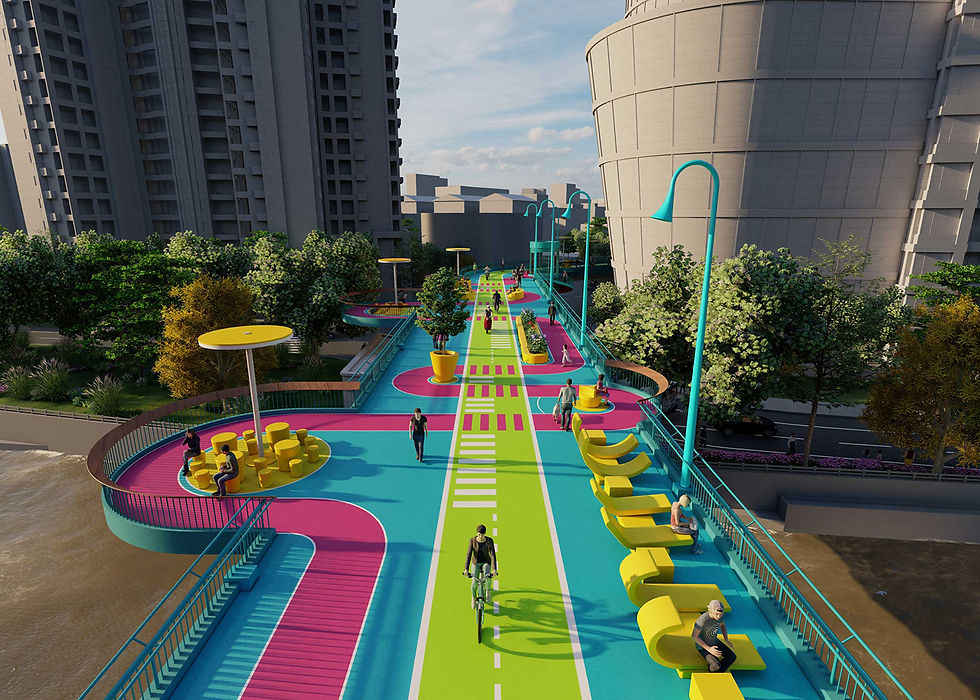

Below I have included photos of some rough sketches depicting the realisation of my bespoke seating. I wanted to conceal the structural columns in a way that tied in with my theme, so I began by drawing an area of my IMP in 1:20 and placing a timber glulam tree around the column. I liked this effect, but I decided a glulam tree was unnecessary as these can actually be used for structural support. As the column is already in place here, there is no need for extra structural support, so this gave me the idea of following a more sculptural, delicate route.


Once this was refined, the end result was a tree-like structure, with large leaves concealing the column. I also included an integrated table and seating so that this could be utilised within the café and sitting areas.
Next, I began to explore fabric membrane tensile details, and how these might look within my design. I sketched some of these details out alongside the effect they would have within the large leaves present in my detail.
Garland Cable Detail

This particular detail includes small garland cables
which run through the fabric membrane (secured with stitching) and clip onto a metal. A strong tensile relationship between the fabric and the metal is established with a hook and wire which pulls the material into the desired shape. I opted against this kind of detail as I wanted a neater, cleaner finish.
Tube in Pocket Detail
This detail features a tube with fabric wrapped around it, which is then secured using stitching. This is attached to the framework using a thin hook. Tension is created here as forces travel perpendicularly to the tube. This is the detail I would like to utilise within my project as it has the cleanest finish.
Edge Clamping Detail
This method attaches the fabric membrane onto a fixed tube which wraps around the fabric, using stitching for security. This is then clamped using another flat strip of metal and screws for extra security. I didn't think that this was necessary for my design, as I will be making more of a sculptural joinery rather than structural, so it doesn't require this level of securing.
Finalised details and junctions will be evidenced within my report.
Material Selection
In terms of material selection within my area of focus, I began by considering the main colour scheme already present within my IMP. First, I arranged all of my selected colours together, then collected textures which related to these that I would like to use throughout my design. The recycled rubber textures which I decided upon for my treehouse-like structures in week 7 have been placed alongside some recycled fabric materials which I would also be using within chairs, bean bags and the bespoke seating leaves.

Sourcing the Fabrics
In terms of sourcing the fabric products, I found a company called Offset Warehouse, which I have included the link for below. They specialise in utilising fabrics which protect the environment and the people who make them.
“You can feel good knowing exactly where your fabric has come from, and who has made it." - Charlie Bradley Ross, Founder Offset Warehouse

The founder began the company after leaving the Royal College of Art in 2009, with a determination to work with exclusively ethically sourced raw materials and production. As she found this to be quite the challenge, particularly for her small purchases, she began the UK based Offset Warehouse in order to solve this issue.

"Now, our customers don’t have to spend hours searching high and low – as I did – for fabulous textiles that benefit the environment and the people who make them. Creating ethical fashions and interiors is now an accessible goal for everyone – we can all make a difference.” - Charlie Bradley Ross, Founder of Offset Warehouse

Fabric:
Khaki Organic Cotton Fleece
09-Fleece-KH-OTR
This is an example of the kind of fabric I would purchase from Offset Warehouse, as it ties in with my colour scheme and the fleeced underside would increase comfort on seats and cushions.
I was particularly keen to use fabric from this company as they are very transparent. They are also UK based, so I greenhouse gas emissions from transportation would be kept to a minimum. Full information is included on how the product was sourced, why it is sustainable and how to care for it in order to ensure its durability. I have included a screenshot of this information below in order to show why I believe this is such a good company for ethically sourced fabrics.
Transparency in successful corporations is something which is very hard to come by, as many are not truly ethical, they just appear to be on the surface without any actual proof. This is why I really appreciated the inclusion of this information so I could make an ethically informed choice within my design. This is a company which I am very keen to support when I enter the design world myself, as it is clear that they genuinely care.


These are some screenshots taken from the Offset Warehouse website depicting the ethical and environmental story behind this particular product.
Sourcing the Rubber

Whilst researching sources for the rubber textures, I found a UK based company called Safer Surfacing, which I have included the link for below.

Safer Surfacing utilise recycled vehicle tires, turned into a range of rubber products which have high durability and versatility. The durability of this product adds to its sustainability, as it will not need to be replaced for a very long time. This is something that I was keen to include within my design, as I wouldn't want to install any materials which needed heavy upkeep. This material is also safe, which is why I was particular drawn to it for my high ropes area and low ropes kids course. This will ensure injuries are minimised, ensuring health and safety within my design. They come with a critical fall height certification according to BS EN1177:2008.

This is the kind of product I would purchase from this website, as it ties in with my colour scheme and is made from recycled materials. As they carry out bespoke services, I would ask for the addition of different colours to match the previous textures that I have chosen, which have more of a speckled effect.
Bespoke Seating Material Overlays
After seeing the colour scheme in realistic textures, I could then assess the materiality which would tie in well within my detailed area. I have numbered each material decision so I can describe my thought process clearly.

I used the fabric material overlays here from my original IMP colour scheme in order to visualise which would work best. This will be certified organic cotton from Offset Warehouse. I chose yellow leaves as I felt the lightest colour would be the most appropriate here, so that it felt uplifting and spacious.
Here, I considered different stains and types of wood, before deciding upon bamboo as it is such a sustainable material due to its fast growing properties. I like the inconsistencies within the material, which add to the organic effect that I am going for. It is also perfect for the tube in pocket type of joinery I am looking to use due to its thinness and malleability.
The certified organic cotton in green compliments the yellow very well. This colour also connotes the outdoors, which ties in with my theme well.
After my experiments with foliage and resin, I was keen to use this within my design as I liked the end result and it fits in with my theme of natural materials. This would need to be covered with a thin sheet of glass to ensure durability. I would ensure that this is recycled and ethically sourced.


Reception Area Material Overlays

With my reception area, I wanted to keep the materials fairly simplistic and raw, due to the vibrant materiality present within the rest of my structure.
For the countertop, I considered a wide range of materials such as coloured recycled fabrics, recycled glass set in concrete, foliage set in resin, and different kinds of wood. My final decision was timber, as my high ropes structure is supported by a timber framework, so this would tie in well. I also like the light colouring of the wood, which keeps it nice and simple to contrast the bright colours within my scheme. The timber I will be using, in particular, will be sustainable sourced from approved forests within the country.
I was keen to keep the concrete flooring, walls and ceiling, as I thought this would already work well with my materials, and I wanted to preserve some of the buildings original materiality.
I wanted to incorporate some kind of vertical cladding into the reception desk, so I experimented with a few different forms such as wood and fabric, until I decided on using bamboo. This has the most organic finish, interesting texture and also ties in with the seating design. I was interested in using bamboo as it is a very flexible and sustainable building material, making it an ethically conscious choice.
I considered a few different materials to divide up the rooms, such as glass, metal shelving with plants, and bamboo dividers. I chose recycled glass with a bamboo divider as I wanted some visibility through to the high ropes and children's areas, but I still wanted to make some clear spatial separation. The use of recycled glass was important to me after learning about the negative impacts of overly collected sand in week 2.
For the space behind the counter, I wanted to add some kind of sign or board. I looked at cork boards, fabrics and bamboo, but I decided to use a darker stained wood in order to add some depth to the colouring. I also chose to feature some hanging foliage, which adds to the natural effect which I am trying to achieve.
All materials will be sourced from local, ethical businesses in order to support the community, help to reduce CO2 emissions via transport, and help the environment.

This is a sketch I did of the counter design in section. It is made up of a timber framework, which is joined together using rabbet joints.
I have also drawn in the bamboo cladding, which is present on the front exterior of the counter.
These are some rough detail drawings that I did exploring the reception desk.


References
Llorens, J. (2018). Rigid Edges for Structural Membranes https://upcommons.upc.edu/bitstream/handle/2117/129583/RIGID%20EDGES%20FOR%20STRUCTURAL%20MEMBRANES.pdf
Schlaich, J. et. al. (2019). Tensile Membrane Structures. Wind Effects on Structures. https://www.semanticscholar.org/paper/Tensile-Membrane-Structures-SCHLAICH-W.SOBEK/b9ab9d803b57b29dec84a30ebca7591594668346
Zwerger, K. (2015). Wood and wood joints. In Wood and Wood Joints. https://www.degruyter.com/document/doi/10.1515/9783035607314/html?lang=en


Comments